
Custom NFC, RFID and Smart Card Manufacturer
100M+ Cards Annually | Original NXP Chips | Since 2011


 2026.10.26


As businesses seek more reliable ways to protect product authenticity and adopt sustainable materials, PET and R-PET cards are becoming options for identification, membership, access control, and anti-counterfeiting applications.
Although these two card materials share a similar chemical foundation, they differ in the origin of their raw materials. Understanding the differences between PET and R-PET cards can help buyers select a suitable solution based on durability, sustainability goals, customization requirements, and security needs.
In this article, we explore how PET and R-PET cards differ, how they can be used in anti-counterfeiting solutions, and what buyers should consider before placing an order.
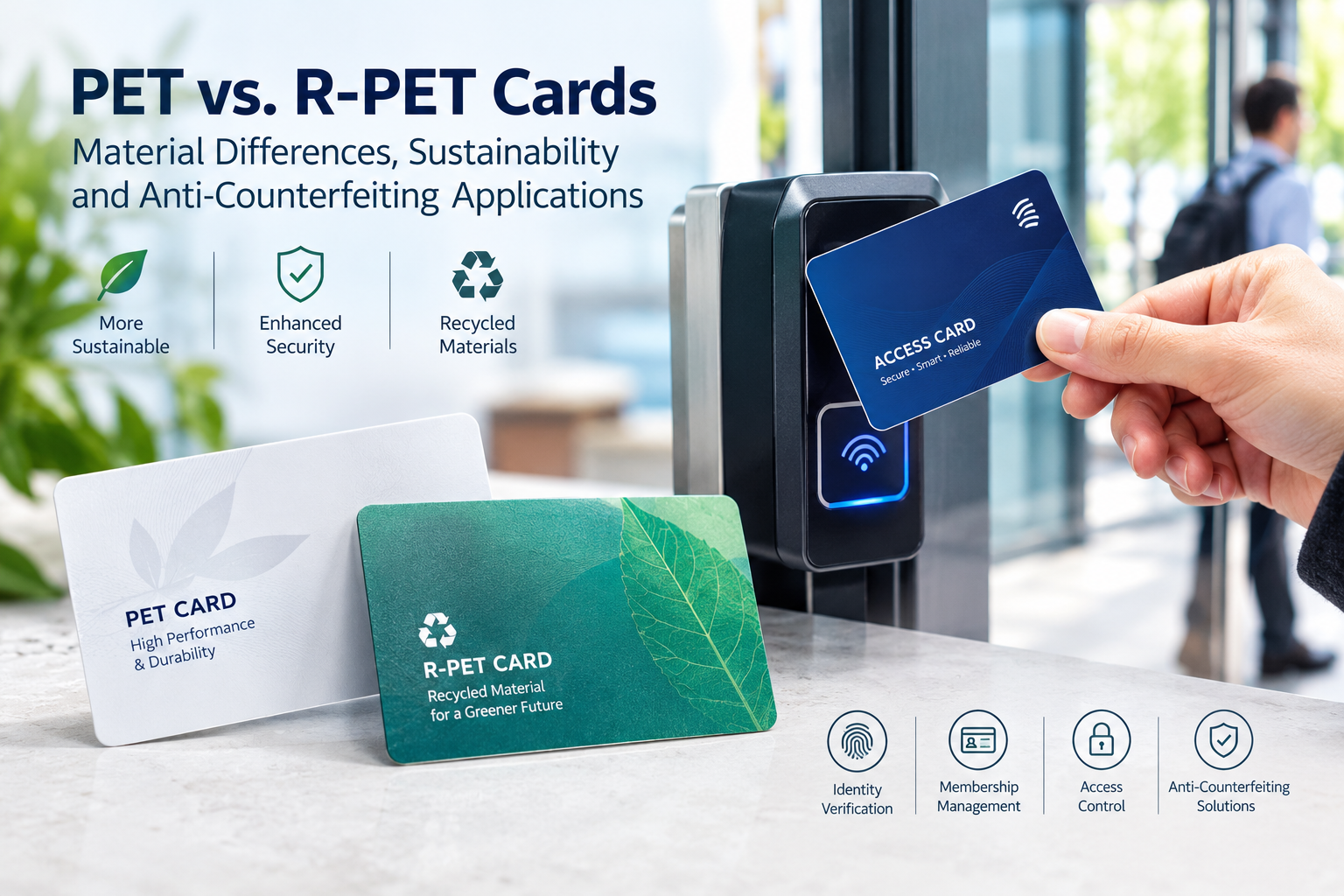
PET stands for polyethylene terephthalate, a thermoplastic polymer widely used in packaging, films, and various industrial products.
In card manufacturing, PET-based materials can be used to produce customized cards for identification, membership programs, access control, and other applications. The finished card's characteristics depend on its material grade, thickness, surface treatment, and manufacturing structure.
Key advantages may include:
Versatile customization: Supports various card designs, colors, and printing options, subject to material compatibility.
Durability: Performance depends on the selected PET grade and card construction.
Smart card integration: RFID or NFC chips can be incorporated into a suitable card design.
Security feature compatibility: Serial numbers, QR codes, barcodes, and selected security printing features can be added according to project requirements.
PET cards are worth considering when businesses need a customized card solution with defined material and performance specifications.
R-PET stands for recycled polyethylene terephthalate. It is made using recovered PET materials that have been processed for reuse.
In card manufacturing, recycled PET may be incorporated into the card body or selected layers, depending on the supplier's manufacturing process and product specifications.
The main appeal of R-PET cards is their potential to reduce reliance on virgin raw materials and support more circular material use.
Potential benefits include:
Recycled material content: Incorporates recycled PET according to the product specification.
Sustainability initiatives: Can support corporate purchasing policies that prioritize recycled materials.
Custom card design: May support printing, personalization, and smart card integration when the material construction is suitable.
Flexible applications: Can be considered for membership cards, identification cards, access control, and selected anti-counterfeiting applications.
Buyers should confirm the actual recycled content percentage and request supporting documentation where necessary. Environmental benefits depend on factors such as material sourcing, manufacturing processes, energy consumption, and product lifespan.
The fundamental difference is the source of the material, not whether the card is inherently more secure.
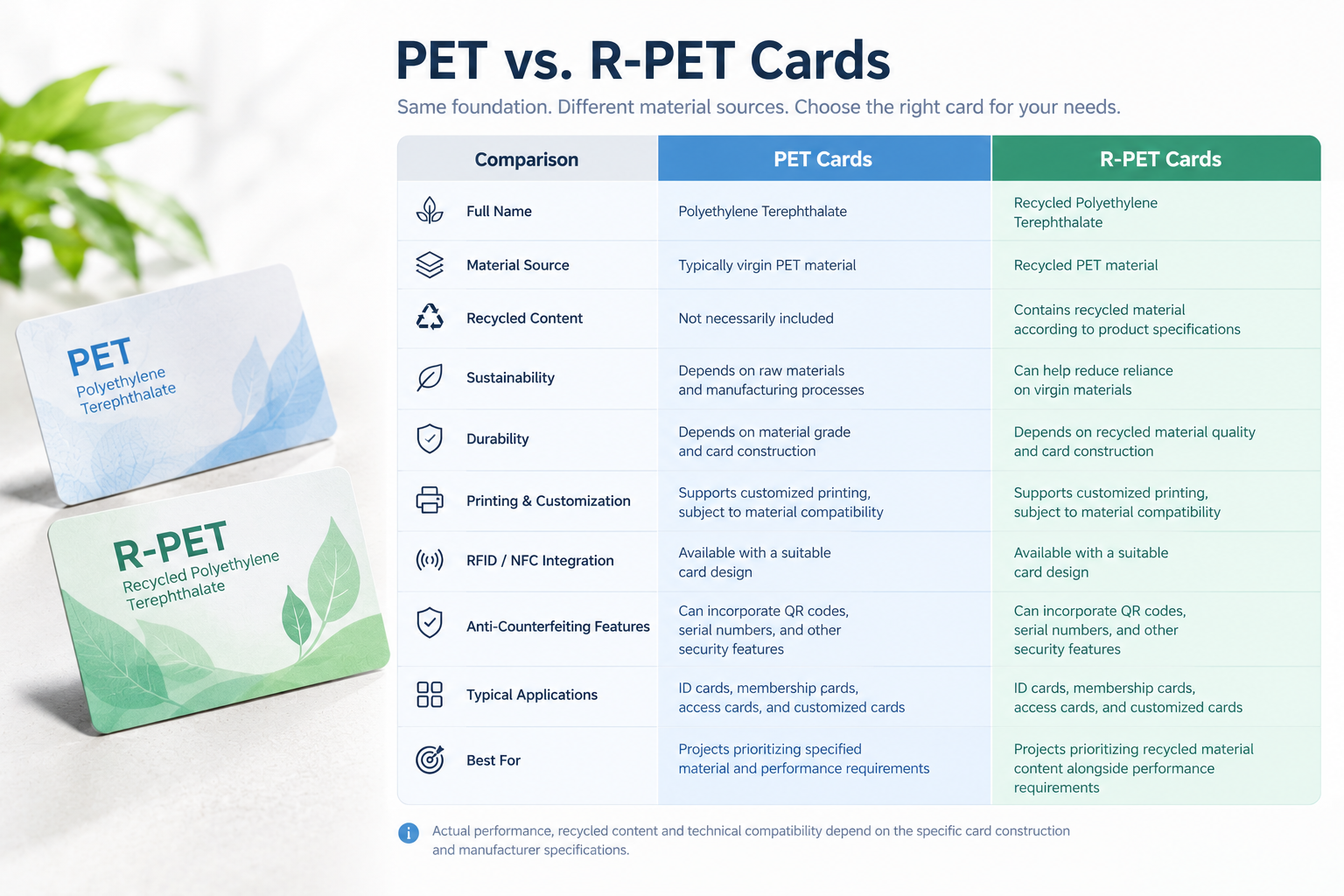
| Feature | PET Cards | R-PET Cards |
|---|---|---|
| Material source | Typically virgin PET-based material, depending on specification | Recycled PET material |
| Recycled content | Not necessarily included | Present according to the declared specification |
| Environmental considerations | Depends on sourcing and production | May reduce demand for virgin PET |
| Durability | Depends on material grade and card construction | Depends on recycled material quality and card construction |
| Printing and customization | Subject to surface treatment and production method | Subject to surface treatment and production method |
| RFID/NFC integration | Possible with a suitable design | Possible with a suitable design |
| Anti-counterfeiting features | Can be incorporated | Can be incorporated |
| Typical selection priority | Defined material and performance requirements | Recycled material content and performance requirements |
Important: R-PET does not automatically mean lower durability, and PET does not automatically mean better performance. The actual result depends on the material formulation, card construction, production quality, and intended use.
Yes. Both PET and R-PET cards can be considered for anti-counterfeiting applications when the finished card meets the relevant technical requirements.
However, anti-counterfeiting performance comes from the security system and its features, not from the PET or R-PET material alone.
Customized graphics, unique serial numbers, variable data, and selected security printing techniques can help distinguish genuine cards from unauthorized copies.
The appropriate combination depends on the required security level and production budget.
A unique QR code can connect a card to a product record or authentication page. When verified against a secure database, it can help confirm whether the associated record is valid.
For stronger protection, the verification system should address copied codes, duplicate registrations, and unauthorized data changes. A QR code by itself does not guarantee authenticity.
PET and R-PET card constructions can accommodate RFID or NFC technology when designed for the selected chip and antenna.
Depending on the system, these cards can support identification, access control, membership management, or product authentication.
For applications requiring stronger security, buyers should evaluate cryptographic authentication, chip capabilities, secure key management, and backend verification rather than relying solely on a card's unique identifier.
Individual card identifiers can be registered in a database to support record management, authorization checks, and traceability.
Combining physical card features with digital verification can help businesses establish a more comprehensive anti-counterfeiting process.
PET and R-PET cards may be used in several industries, depending on the product specifications and security requirements.
Brand Protection and Product Authentication
Customized cards can provide a link between a physical product and its digital authentication record, helping brands implement verification and product registration processes.
Membership and Loyalty Programs
Businesses can use customized cards with printed identifiers, QR codes, barcodes, or compatible RFID technology to support member identification and customer management.
Access Control and Identification
Cards can be configured for compatible access control systems, employee identification, and visitor management.
Sustainable Corporate Card Programs
Organizations seeking to increase the use of recycled materials can evaluate R-PET cards as part of their material selection and sustainability strategies.
Before selecting PET or R-PET cards, buyers should consider five factors.
1. Application requirements
Identify whether the card is intended for authentication, access control, membership, identification, or another purpose.
2. Material specifications
Confirm the material composition, thickness, card structure, and required durability. For R-PET, verify the recycled content percentage.
3. Printing and customization
Check compatibility with the intended printing method, surface finish, variable data, and additional security features.
4. Smart card requirements
For RFID or NFC projects, confirm the required frequency, chip type, antenna design, reader compatibility, and security functions.
5. Total project cost
Compare material, manufacturing, personalization, encoding, security features, testing, and expected service life rather than evaluating the material price alone.
PET and R-PET cards can both be suitable options for customized card applications. The best choice depends on the balance between material performance, recycled content, printing requirements, security features, and budget.
For projects where recycled material content is a priority, R-PET is worth evaluating against the required performance specifications. For other projects, PET-based materials may be selected according to the card structure and application requirements.
For anti-counterfeiting applications, the most effective solution combines suitable card materials with appropriate security features, unique identification, and a reliable verification process.
Looking for customized PET or R-PET cards?
Union Smart can help evaluate card material options, printing requirements, RFID/NFC integration, and anti-counterfeiting features based on your project specifications.
Contact our team to discuss your customized card requirements and identify a suitable solution for your market.