Custom NFC, RFID and Smart Card Manufacturer
100M+ Cards Annually | Genuine NXP Chips | Since 2011


 2026.11.22


Choosing the right NFC chip is an important step when developing NFC cards, smart labels, product authentication tags, or interactive packaging. Among NXP's popular NFC chips, NTAG213, NTAG216, and NTAG424 DNA are frequently considered for different applications.
But what is the difference between NTAG213, NTAG216, and NTAG424 DNA? Which chip offers more memory? Which one is better for product authentication and anti-counterfeiting?
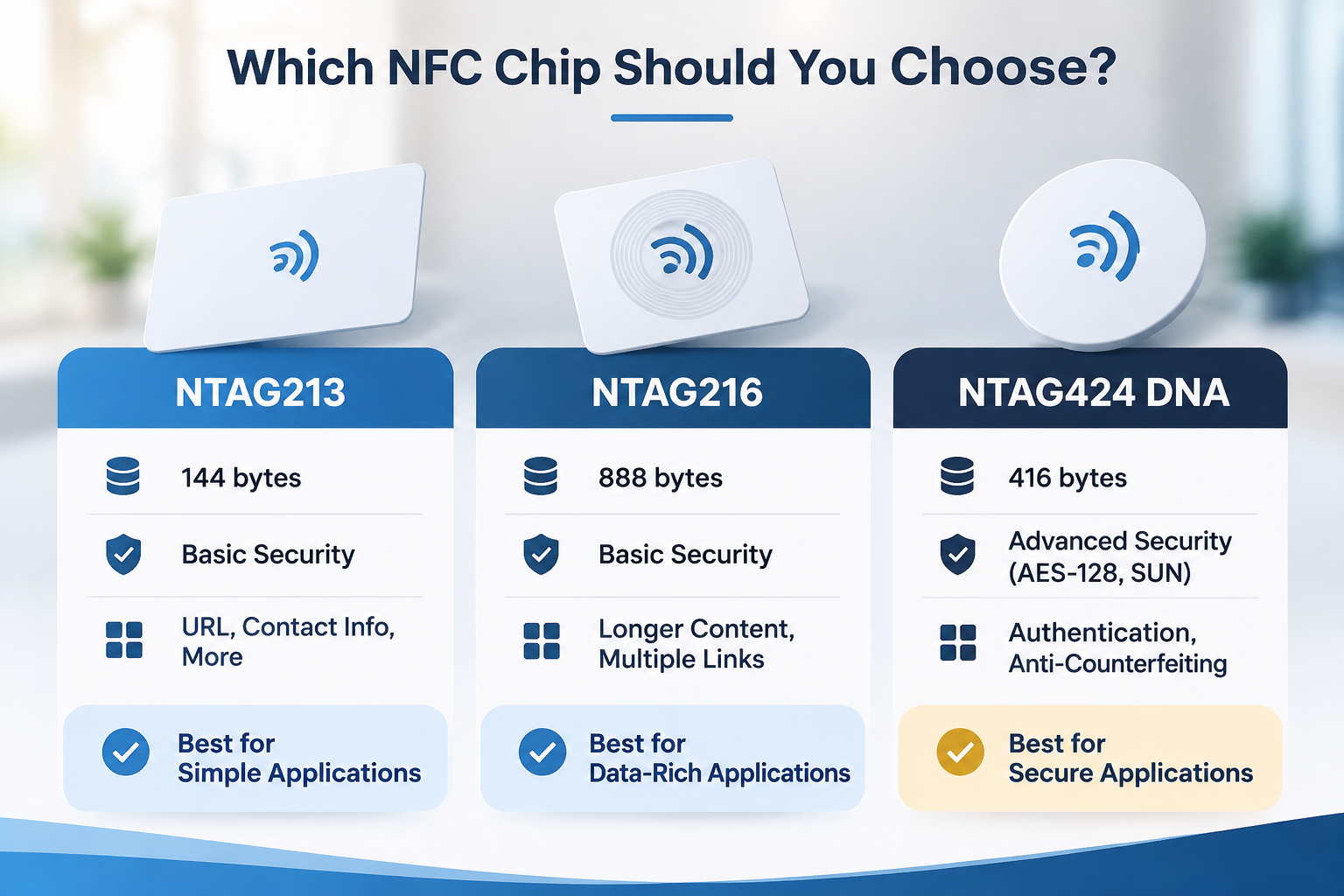
NTAG213 is ideal for simple NFC applications, such as opening URLs, sharing contact information, and accessing digital content.
NTAG216 is suitable for applications requiring more memory, including longer URLs, larger NDEF messages, and multiple data records.
NTAG424 DNA is designed for secure NFC applications, offering AES-128 cryptography and Secure Unique NFC (SUN) authentication for product authentication and brand protection.
The best NFC chip depends on your data storage requirements, security level, application, and project budget.
NTAG213 vs NTAG216 vs NTAG424 DNA: Key Differences
The main differences between these three NFC chips are memory capacity, communication standards, and security capabilities.
| Feature | NTAG213 | NTAG216 | NTAG424 DNA |
| Manufacturer | NXP | NXP | NXP |
| NFC Standard | Type 2 Tag | Type 2 Tag | Type 4 Tag |
| User Memory | 144 bytes | 888 bytes | 416 bytes total |
| NDEF Storage | Up to 144 bytes, subject to formatting | Up to 888 bytes, subject to formatting | 256-byte NDEF file |
| Frequency | 13.56 MHz | 13.56 MHz | 13.56 MHz |
| Security | 32-bit password protection | 32-bit password protection | AES-128 cryptography |
| SUN Authentication | No | No | Yes |
| Best For | Basic NFC applications | Larger data storage | Secure NFC authentication |
**Important:** NTAG424 DNA has 416 bytes of total memory, including a 32-byte Capability Container, a 256-byte NDEF file, and a 128-byte protected data file. Its 416-byte total memory should not be compared directly with the NDEF user memory of NTAG213 or NTAG216.
What Is the Difference Between NTAG213 and NTAG216?
NTAG213 and NTAG216 belong to the NXP NTAG21x family. Both are NFC Forum Type 2 Tag chips and support common NFC applications.
Their primary difference is memory capacity.
NTAG213 – Cost-Effective NFC Chip for Basic Applications
NTAG213 provides 144 bytes of user memory, making it suitable for storing short URLs, website links, contact information, and simple NFC commands.
Common applications include:
- NFC business cards
- Smart product labels
- URL redirect tags
- NFC marketing and advertising
- Wi-Fi connection tags
- Digital information tags
For projects that only require a smartphone to scan an NFC tag and open a webpage, NTAG213 is usually sufficient.
NTAG216 – More Memory for Complex NFC Applications
NTAG216 provides 888 bytes of user memory, significantly more than NTAG213.
It is a better choice when an NFC project requires longer data records, multiple NDEF records, or more complex contact information.
Common applications include:
- NFC business cards with more contact information
- Multi-link NFC tags
- Smart product labels with larger data records
- Digital information tags
- Applications requiring additional writable memory
NTAG213 vs NTAG216: Which is better?
NTAG216 is not necessarily better for every project. If your application only needs a short URL, NTAG213 can do the job. If your encoded data exceeds NTAG213's available capacity, NTAG216 offers more flexibility.
Both chips support configurable 32-bit password protection and locking functions. However, password protection is not equivalent to cryptographic authentication.
What Makes NTAG424 DNA Different?
Unlike NTAG213 and NTAG216, NTAG424 DNA is designed for security-focused NFC applications.
It uses AES-128 cryptography and Secure Unique NFC (SUN) technology to generate a unique, authenticated message each time the chip is scanned.
This makes it suitable for applications where simply opening a webpage is not enough. Businesses may also need to verify whether a product or NFC tag is genuine.
Key Security Features of NTAG424 DNA
AES-128 Encryption
NTAG424 DNA supports AES-128 cryptographic operations to protect sensitive data and enable secure authentication.
SUN Authentication
Each NFC tap can generate a unique authentication message. A connected backend server can verify the message to help identify genuine tags and detect copied or manipulated NFC data.
Secure Data Access
The chip supports mutual authentication and protected communication, allowing sensitive data to be accessed under configured security permissions.
Privacy Protection
Random ID and encrypted UID features help improve user privacy and reduce the exposure of fixed chip identifiers.
Common Applications of NTAG424 DNA
- NFC product authentication
- Anti-counterfeiting labels
- Brand protection
- Smart packaging
- Luxury product authentication
- Digital product engagement
- Secure NFC membership cards
- Collectible and IP authentication cards
For product authentication projects, NTAG424 DNA is a stronger choice than NTAG213 or NTAG216 when cryptographic verification is required. However, a complete authentication solution also needs appropriate key management, backend verification, and system integration.
Which NFC Chip Should You Choose for Your Project?
The following examples can help you select the right chip for your application.
| Application | Recommended Chip | Reason |
| NFC Business Cards | NTAG213 / NTAG216 | Depends on contact data size |
| NFC Website Links | NTAG213 | Sufficient for most short URLs |
| NFC Smart Labels | NTAG213 / NTAG216 | Depends on stored data |
| NFC Marketing Cards | NTAG213 / NTAG216 | Cost-effective data access |
| Product Authentication | NTAG424 DNA | AES-128 and SUN authentication |
| Anti-Counterfeiting Labels | NTAG424 DNA | Supports cryptographic verification |
| Smart Packaging | NTAG424 DNA | Secure product interaction |
| Luxury Brand Protection | NTAG424 DNA | Supports backend-based authentication |
| Secure NFC Cards | NTAG424 DNA | Advanced data protection |
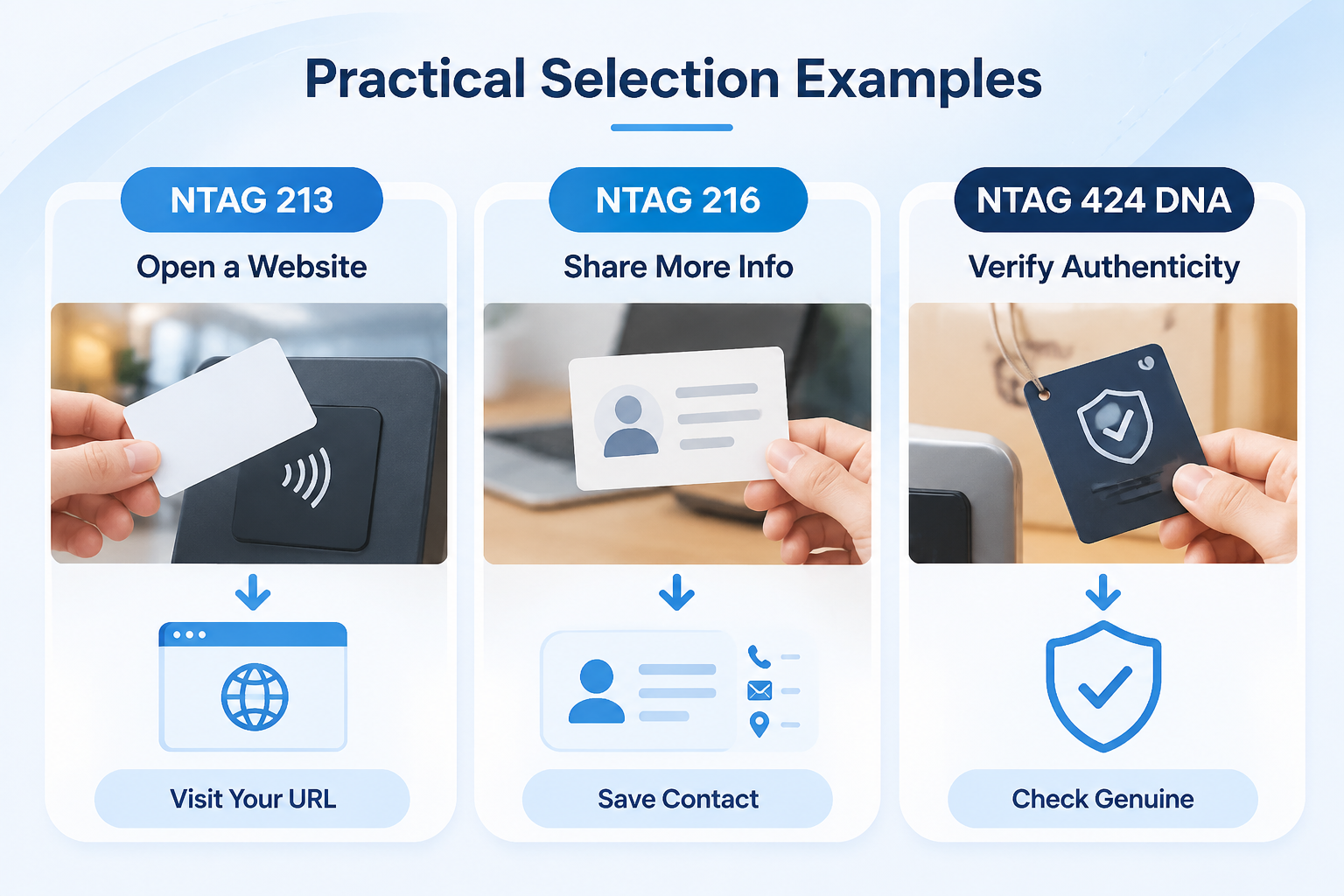
Practical Selection Example
Scenario 1: A company wants NFC cards that open its website.
NTAG213 is generally sufficient because the card only needs to store a short URL.
Scenario 2: A company wants NFC business cards with multiple contact details and digital information.
NTAG216 may be a better option because it offers more user memory.
Scenario 3: A brand wants customers to verify product authenticity by scanning an NFC label.
NTAG424 DNA is recommended because its SUN authentication mechanism enables the backend to verify each tap.
These examples illustrate why NFC chip selection should be based on actual application requirements rather than simply choosing the chip with the largest memory capacity.
Custom NTAG213, NTAG216 and NTAG424 DNA NFC Cards & Tags
At Union Smart, we manufacture custom NFC cards and tags using NXP chips for different business and industrial applications.
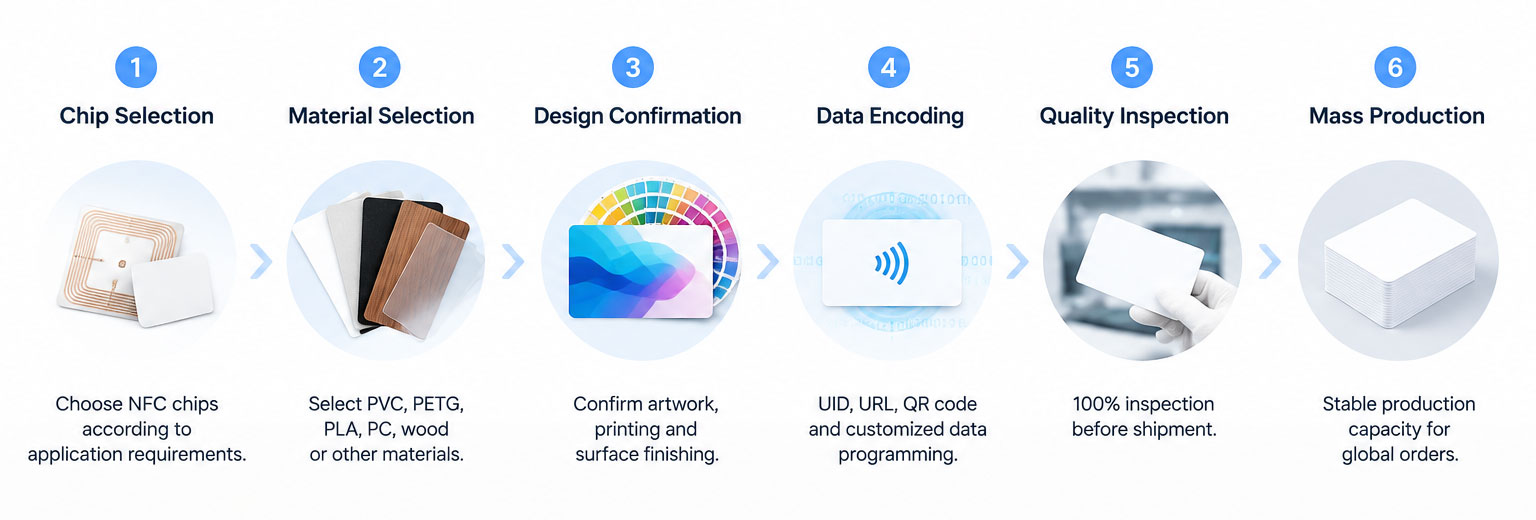
We provide OEM and ODM customization services, helping customers select suitable NFC chips, materials, antenna designs, printing options, and data encoding solutions.
Our customization capabilities include:
NXP Chip Selection:NTAG213, NTAG216, NTAG424 DNA, and other NFC chip options.
Material Options: PVC, PET, PETG, PC, PLA, wood, bamboo, and other customized materials.
Custom Printing: Full-color printing, logo printing, and personalized card designs.
Data Encoding: URL, UID, QR code, NDEF, and customized data programming.
NFC Card & Tag Manufacturing: Custom dimensions, shapes, antenna structures, and product formats.
Quality Inspection: Production quality control and functional testing.
Whether you need standard NFC cards for marketing or secure NTAG424 DNA tags for product authentication, our team can help develop a suitable NFC solution for your project.
Looking for a reliable NFC card and tag manufacturer?
Contact Union Smart to discuss your NTAG213, NTAG216, or NTAG424 DNA NFC card and tag requirements.
Website: https://www.usocard.com/
Frequently Asked Questions
**Q1: What is the main difference between NTAG213 and NTAG216?**
The main difference is memory capacity. NTAG213 provides 144 bytes of user memory, while NTAG216 provides 888 bytes. Both are NFC Forum Type 2 Tag chips.
**Q2: Is NTAG216 more secure than NTAG213?**
No. NTAG216 provides more memory, but it does not offer the AES-128 cryptographic authentication available in NTAG424 DNA. Both NTAG213 and NTAG216 support configurable 32-bit password protection.
**Q3: Is NTAG424 DNA better than NTAG213?**
For secure product authentication and anti-counterfeiting applications, NTAG424 DNA offers more advanced security features. For basic URL sharing and simple NFC interactions, NTAG213 is usually more cost-effective.
**Q4: Can NTAG424 DNA prevent NFC tag cloning?**
NTAG424 DNA uses AES-128 cryptography and SUN authentication to help detect copied or manipulated tag data. Its security depends on proper cryptographic key management and backend verification. No chip alone guarantees complete protection against every type of attack.
**Q5: Can NTAG213, NTAG216, and NTAG424 DNA be used in custom NFC cards?**
Yes. All three chips can be integrated into custom NFC card products. The final design depends on the chip, antenna structure, card material, dimensions, and intended application.
**Q6: Which NFC chip is best for product authentication?**
NTAG424 DNA is a strong choice for product authentication because it supports AES-128 cryptography and SUN authentication. It is particularly suitable for brands that need to verify individual product interactions through an online authentication system.
Union Smart – Custom NFC & RFID Card and Tag Manufacturer
We provide OEM and ODM NFC/RFID cards, labels, and tags for global businesses, brand owners, distributors, and solution providers.