Custom NFC, RFID and Smart Card Manufacturer
100M+ Cards Annually | Original NXP Chips | Since 2011


 2026.11.03


Combining UHF RFID Technology with Temperature and Humidity Sensing
Temperature and humidity monitoring plays an important role in cold chain logistics, pharmaceutical storage, food transportation, and industrial warehousing.
Traditional temperature and humidity monitoring often relies on standalone sensors or manual inspection. These methods may require additional operations to collect environmental data and identify the corresponding products or packages.
UHF RFID temperature and humidity sensor labels provide an alternative approach by combining wireless identification with environmental sensing technology.
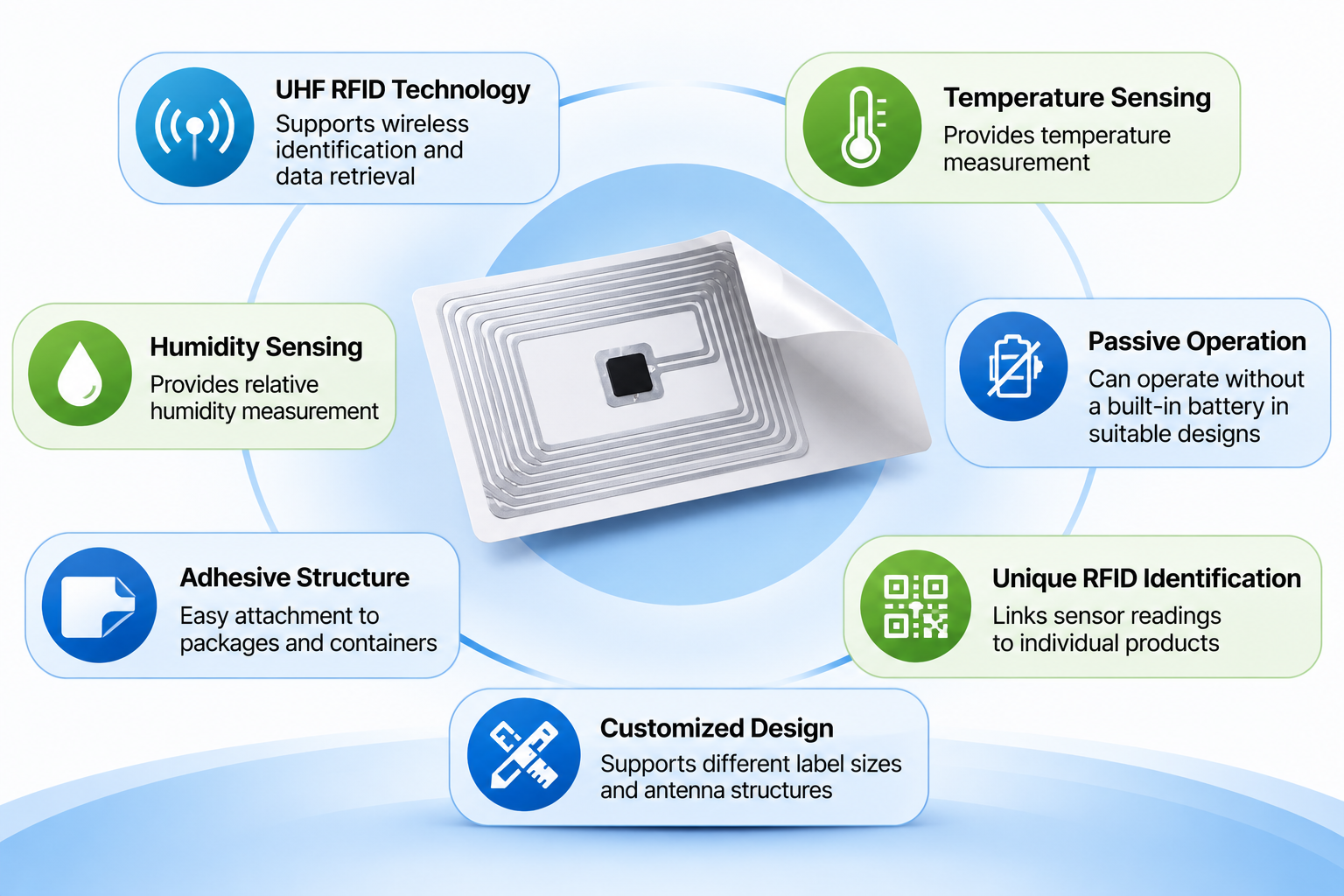
By integrating a UHF RFID sensor IC, a temperature and humidity sensing element, and an adhesive label structure, businesses can identify tagged products and retrieve environmental measurement data using compatible UHF RFID readers.
Union Smart specializes in RFID/NFC label and card manufacturing. We provide customized UHF RFID sensor label solutions for customers developing smart logistics, cold chain monitoring, and industrial environmental management systems.
This case explores how adhesive UHF RFID temperature and humidity labels can support product identification and environmental monitoring across different industries.
What Is a UHF RFID Temperature and Humidity Sensor Label?
A UHF RFID temperature and humidity sensor label is an RFID-enabled sensing product designed to identify tagged items and collect environmental measurement data through compatible UHF RFID readers.
Unlike conventional UHF RFID labels that mainly provide product identification, sensor-enabled RFID labels can also provide temperature and humidity information.
A typical label consists of the following components:
- **UHF RFID Sensor IC:** Processes RFID communication and sensor data.
- **RFID Antenna:** Enables wireless communication with UHF RFID readers.
- **Temperature Sensor:** Measures the surrounding temperature.
- **Humidity Sensor:** Measures relative humidity (RH).
- **Label Face Material:** Provides protection and a printable surface.
- **Adhesive Layer:** Allows the label to be attached to cartons, packages, containers, and other suitable surfaces.
- **Release Liner:** Protects the adhesive before application.
The label can be designed in a flexible adhesive format, making it suitable for integration into existing product labeling and packaging processes.
The exact sensing architecture depends on the selected sensor IC. Some solutions integrate sensing functions into the RFID IC, while others require external temperature or humidity sensing components.
Key Applications of UHF RFID Temperature and Humidity Labels
### 1. Pharmaceutical Cold Chain Monitoring
Pharmaceutical products, vaccines, and biological materials may require controlled storage and transportation environments.
UHF RFID temperature and humidity sensor labels can be attached to suitable packages or containers to support product identification and environmental data collection.
Key applications include:
- Pharmaceutical package identification.
- Temperature monitoring during transportation.
- Humidity monitoring in storage environments.
- Cold chain inventory management.
- Association of sensor readings with product batch information.
### 2. Food Cold Chain Logistics
Temperature and humidity are important environmental factors in the storage and transportation of fresh food, seafood, meat, and dairy products.
UHF RFID sensor labels can help logistics operators identify tagged packages and retrieve environmental measurements during RFID inspection.
Typical applications include:
- Fresh food transportation.
- Seafood storage and distribution.
- Refrigerated warehouse management.
- Food packaging identification.
- Cold chain environmental monitoring.

### 3. Electronic Components and Moisture-Sensitive Materials
Many electronic components require controlled storage conditions to reduce moisture-related quality risks.
UHF RFID temperature and humidity labels can be integrated into electronic component packaging or storage containers.
Typical applications include:
- Electronic component warehouse management.
- PCB and semiconductor material storage.
- Moisture-sensitive component monitoring.
- Packaging identification.
- Environmental data association with product batches.
For moisture-sensitive electronics, the sensor type and placement should be selected according to the actual measurement requirement. Air humidity measurement and material moisture detection are not interchangeable.
### 4. Pharmaceutical Warehousing
Pharmaceutical warehouses often need to monitor environmental conditions across different storage areas.
UHF RFID sensor labels can support the identification of tagged packages and the collection of temperature and humidity readings during inventory inspections.
Typical applications include:
- Medicine storage management.
- Medical consumables inventory.
- Warehouse environmental inspections.
- Batch identification and tracking.
- Storage condition monitoring.
### 5. Industrial Material Storage
Certain industrial materials, chemicals, and raw materials require controlled environmental conditions during storage.
UHF RFID temperature and humidity sensor labels can help associate environmental readings with identified packages, containers, and inventory records.
Typical applications include:
- Industrial raw material identification.
- Warehouse environmental monitoring.
- Packaging moisture monitoring.
- Storage condition inspections.
- Material inventory management.
## 4. How Does a UHF RFID Temperature and Humidity Label Work?
A typical UHF RFID sensor label solution involves five steps:
**Step 1: Label Attachment**
The adhesive RFID temperature and humidity label is attached to a suitable package, carton, container, or storage item.
**Step 2: Product Identification**
Each RFID label is associated with a unique identification record in the customer's management system.
**Step 3: UHF RFID Reading**
A compatible UHF RFID reader sends radio-frequency signals to activate the passive RFID sensor label.
**Step 4: Sensor Data Retrieval**
Depending on the sensor IC architecture, the reader retrieves available temperature and humidity measurements through the RFID communication interface.
**Step 5: Data Management**
The RFID identification information and sensor readings can be transmitted to a management platform for environmental monitoring, inventory management, and data analysis.
The system can be configured to associate sensor readings with product IDs, batch numbers, storage locations, and inspection records.
**Important:** A standard passive RFID sensor label generally provides readings when interrogated by a compatible reader. Continuous autonomous monitoring and historical data logging require additional capabilities, such as onboard memory, scheduled sampling, or a battery-assisted architecture.
## 5. Technical Features and Advantages of UHF RFID Sensor Labels
### Why Choose UHF RFID?
UHF RFID operates in regional frequency bands within approximately 860–960 MHz, depending on local regulations.
Compared with short-range HF/NFC applications, UHF RFID is particularly suitable for logistics and warehouse environments where multiple tagged items may need to be identified using fixed or handheld readers.
Its advantages include:
- Longer reading distances under suitable conditions.
- Bulk identification of multiple tags.
- Integration with warehouse management systems.
- Compatibility with established UHF RFID infrastructure.
Actual reading performance depends on the reader, antenna, tag design, mounting surface, and surrounding environment.
## 6. Customized UHF RFID Temperature and Humidity Labels by Union Smart
As an RFID label manufacturer, Union Smart provides customized RFID label manufacturing solutions for different industrial and logistics applications.
For UHF RFID temperature and humidity sensor labels, customization can include:
1. Sensor Chip Selection
2. Adhesive Label Materials
3. Antenna Customization
4. Label Dimensions and Structure
5. Printing and Personalization
6. Product Testing.
Frequently Asked Questions
**Q1: What is a UHF RFID temperature and humidity sensor label?**
It is an RFID label that combines UHF wireless communication with temperature and humidity sensing capabilities. It allows compatible UHF RFID readers to identify tagged items and retrieve available sensor measurements.
**Q2: Does a UHF RFID temperature and humidity label require a battery?**
Some passive sensor label solutions operate using energy harvested from the UHF RFID reader and do not require an onboard battery. Battery-assisted solutions are also available for applications requiring autonomous sensing or data logging.
**Q3: Can UHF RFID sensor labels monitor both temperature and humidity?**
Yes. Suitable sensor architectures can measure both temperature and relative humidity. The design may use an integrated sensing IC or an RFID IC combined with external sensing components.
**Q4: Can these labels be attached to cardboard boxes and plastic containers?**
Yes. Adhesive label structures can be designed for cardboard and plastic packaging. Different adhesive materials and antenna structures may be required for other surfaces, especially metal.
**Q5: Can UHF RFID sensor labels record historical temperature and humidity data?**
This depends on the selected sensor architecture. Basic passive sensor labels typically provide measurements when interrogated by a reader. Historical logging requires additional memory and sampling capabilities.
**Q6: Can Union Smart manufacture customized UHF RFID temperature and humidity labels?**
Union Smart can provide customized RFID label manufacturing solutions, including chip integration, antenna design, adhesive materials, label dimensions, printing, and functional testing, subject to project requirements and component availability.